
Dagala Thousand Lakes Trek
OVERVIEW OF TOUR | 13 DAYS / 12 NIGHTS
As you step off the plane in Paro, you’ll be greeted by breathtaking views of the Himalayas, a stunning conclusion to one of the world’s most spectacular mountain flights. Our representative from Inner Essence Travels will welcome you at the airport exit, ensuring a seamless transition into your Bhutanese adventure. Following lunch, you’ll embark on an afternoon of discovery in Paro, visiting the Ta Dzong Museum, home to an impressive collection of religious relics, artworks, and handicrafts that offer a fascinating glimpse into Bhutan’s rich cultural heritage. Next, you’ll explore the majestic Rimpong Dzong, adorned with vibrant paintings, including the revered image of Milarepa, the great saint and master of meditation. As the day draws to a close, you’ll drive to Thimphu, the capital city, along the picturesque Pachu River, with an orientation on Bhutanese etiquette awaiting you at your hotel, preparing you for the unique cultural experiences that lie ahead.
After breakfast hike to Taktsang Monastery. The walk of approximately 1.5 to 2 hours uphill takes you almost a kilometre above the Paro valley floor (for those who cannot hike we will arrange a horse for transfer up to cafeteria). The view of Taktsang Monastery built on a sheer cliff face 900 metres above the valley floor is a spectacular sight. The Monastery is an important pilgrim site for Buddhists. According to legend, great Guru Rimpoche and his consort mediated in a cave here for three months when he brought the teachings of the Buddhist Dharma to Bhutan in the 8th Century. After meditation, they manifested themselves in the forms of Guru Dorji Drolo and a tigress to subdue demons in the valley below.
In the afternoon drive to the almost fully reconstructed Drukgyel Dzong. The original monument (destroyed by fire in 1951) was built by Shabdrung to commemorate his victory against invading Tibetans in 1644. In fine weather the towering peak of the sacred Mount Jomolhari (7314m) appears as a stunning backdrop. On the return drive to Paro, visit other sights in Paro valley. Overnight at your hotel in Paro.
Drive to the village of Genekha (2800m) to commence the trek. After crossing a bridge over the Wang Chu (Thimphu River), we follow a good track steadily upwards through oak forest to a rocky platform and good resting spot. We continue slowly up through birch and bamboo forest to reach our camp in a meadow at Gur (3350m). Overnight at campsite.
We head upwards from Gur on a good trail to reach the alpine zone with open views down the valley. We soon reach a possible campsite at Gibze Kebze (3710m) where we may camp, for although we have only been walking for a couple of hours, the height gain is 360m and you will start to feel the altitude. If everyone is acclimatizing well, we may carry on across hillsides lined with rhododendron to Pagalabsta La Pass (4170m) for fine views of the Dagala range. Continue downwards to a stone yak herders hut at Wataching (4100m). Overnight at campsite.
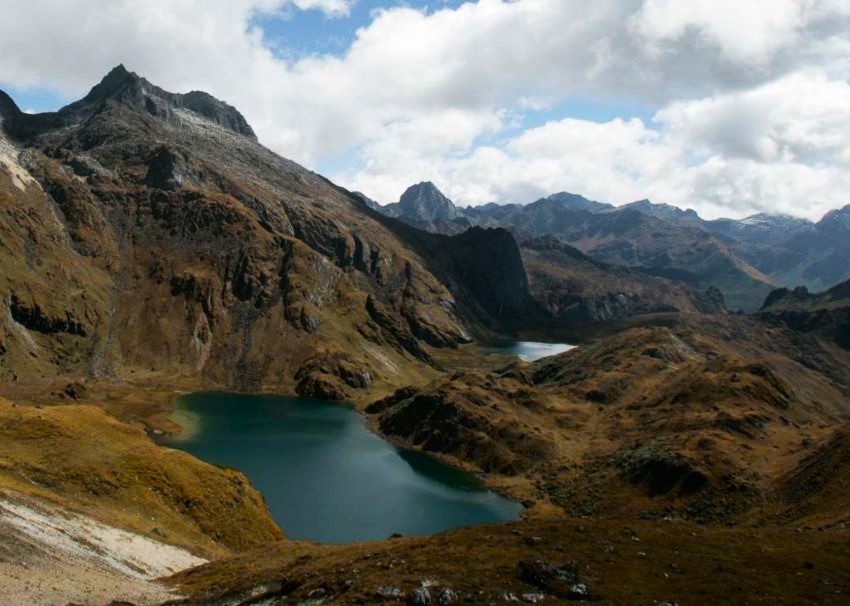
From Wataching we cross several ridges gradually entering more rugged terrain, and follow a broad valley known locally as Labatama, dotted with several yak herders’ huts. We follow the valley to its end to a dramatic campsite below cliffs near to Utsho Lake (4250m), famous for its golden trout. There is time to explore this area and perhaps to climb Jomo if weather and energy allow. The route to Jomo Passes Setsho Lake and from its summit in fine weather are views of Kanchenjunga and Chomolhari. Jomo represents the female deity which protects animals and is much revered, as most people in the vicinity rely on cattle or horses for their livelihood. Juniper will be burned and locals may request that we stop at the lower peak (4530m) as a mark of respect. Overnight at campsite.
Leaving Labatama, we cross Labajong La Pass (4400m). For those with energy to spare there is a good view point close to the pass (Approx 30 mins detour). From here there are several camps to choose from. Depending on the availability of water, our camps may vary pre and post monsoon, but we will aim for Panka. If we climb take a different route to Panka. Overnight at campsite.
A clear early morning will reveal breathtaking views of Kanchenjunga, Chomolhari and Jichu Drake amongst many more Himalayan peaks. The path continues on through a forest of rhododendrons populated by Himalayan pheasants. We reach enormous cairns at Chole La Pass (4100m). From here, we drop down to Kiwi Chowa (4030m). Our route then continues to a pass at 3960m where four tracks converge. We follow the northern route past a ruin said to have once been a dzong to monitor the movement of locals between Wangduephodrang & Thimphu districts. A ridge leads to Talakha Peak (4300m) revealing great views of the Thimphu Valley. If there is a good weather, Kanchenjunga, Chomolhari and Jichu Drake should be visible from here. From Talakha peak we drop down steadily, sometimes steeply, to reach a mixed forest of fir, juniper, rhododendron, rose, bamboo and birch. Finally we reach Talakha Monastery whose shy monks, tremendous views over the Thimphu valley and outdoor bathtub make for a memorable stay. Overnight at a campsite near the monastery.
It’s only an hour’s walk down to the road head and soon we are driving through apple orchards to reach Thimphu, the capital of Bhutan. After checking into your hotel and enjoy some time to unwind and eat lunch, enjoy sightseeing around Thimphu, once a rustic village sitting in a broad river valley and today the nation’s capital. Visit the National Memorial Chorten, completed by the Royal Queen Mother as a memorial stupa for the Third King. Continue on to 12th century Changangkha Temple and the Zilukha Nunnery. Overnight at your hotel in Thimphu.
Continue sightseeing in Thimphu. Visit the School for Arts and Crafts, The National Library housing the collection of Bhutanese scriptures dating back to the 8th century, the Traditional Paper Factory and a fascinating replica of a medieval farmhouse at the Folk Heritage Museum. If there is time, you may visit the nursing pen for the Takin, the national animal of Bhutan, and Tashichhodzong, ‘the fortress of the glorious religion’ housing some ministries, His Majesty’s secretariat, and the central monk body. Other options for the day include a hike to Tango and Cheri Monasteries (45 mins), two of the most ancient monasteries in the Thimphu region. If your visit coincides with the weekend, you can walk through the Thimphu Market. Overnight at your hotel in Thimphu.
Drive over the Dochu-La pass (3,100 meters), which on a clear day offers an incredible view of Himalayan peaks before descending into balmy Punakha valley (about 3 hrs total driving time). The drive through the countryside affords a glimpse of everyday life in this most remote of Himalayan kingdoms. In the Dochu-La area there are vast Rhododendron forests that grow to tree size and bloom in late April/early May covering the mountains in a riot of glorious spring colour.
Punakha was the ancient capital of Bhutan. On arrival, visit Punakha Dzong, the “Palace of Great Happiness” built in 1637 by the Shabdrung, the ‘Unifier of Bhutan’. It is situated at the confluence of the Mo Chu and Pho Chu (Mother and Father Rivers) and is the winter headquarters of the Je Khenpo and hundreds of monks who move en masse from Thimphu to this warmer location. The three story main temple of the Punakha Dzong is a breathtaking example of traditional architecture with four intricately embossed entrance pillars crafted from cypress and decorated in gold and silver. It was here in 1907 that Bhutan’s first king was crowned.
After lunch, enjoy a walk to Chimi Lhakhang, temple of the Drukpa Kuenly who is also known as the Divine Madman. He inherited the Divine Madman title since he revolted against the orthodox Buddhism in his time. He taught the people that religion is an inner feeling and it’s not necessary that one should be an ordained monk. He is also considered a symbol of fertility and most childless couples go to his temple for blessing. Overnight at your hotel in Punakha/ Wangduephodrang.
In the morning drive to Yabesa village and hike to through ricefields and up to Khamsum Yueley Namgyal Chorten, built by her majesty the queen Ashi Tshering Yangdon Wangchuk. Perched high on a hill on the bank of the river, the Chorten houses paintings belonging to Nyingmapa Traditions.
Take a picnic lunch on a riverside before enjoying a pleasant walk through farmland and along the picturesque river bank back to Punakha Dzong.
Drive back to Thimphu where you will have an opportunity to visit handicraft and souvenir stores. Overnight at your hotel in Thimphu.
The day is at leisure to relax in Thimphu before departing for Paro, or return to Paro early to further explore the beautiful Paro valley. Overnight at your hotel in Paro.
Breakfast in the hotel, then drive to the airport for flight to your onward destination. Tashi Delek!
Price Includes
Price Excludes
– Travel & Health Insurance
– Additional personal expenses such as souvenirs, meals, snacks, alcohol, laundry, tips, and gratuities for the tour leader and staff.